
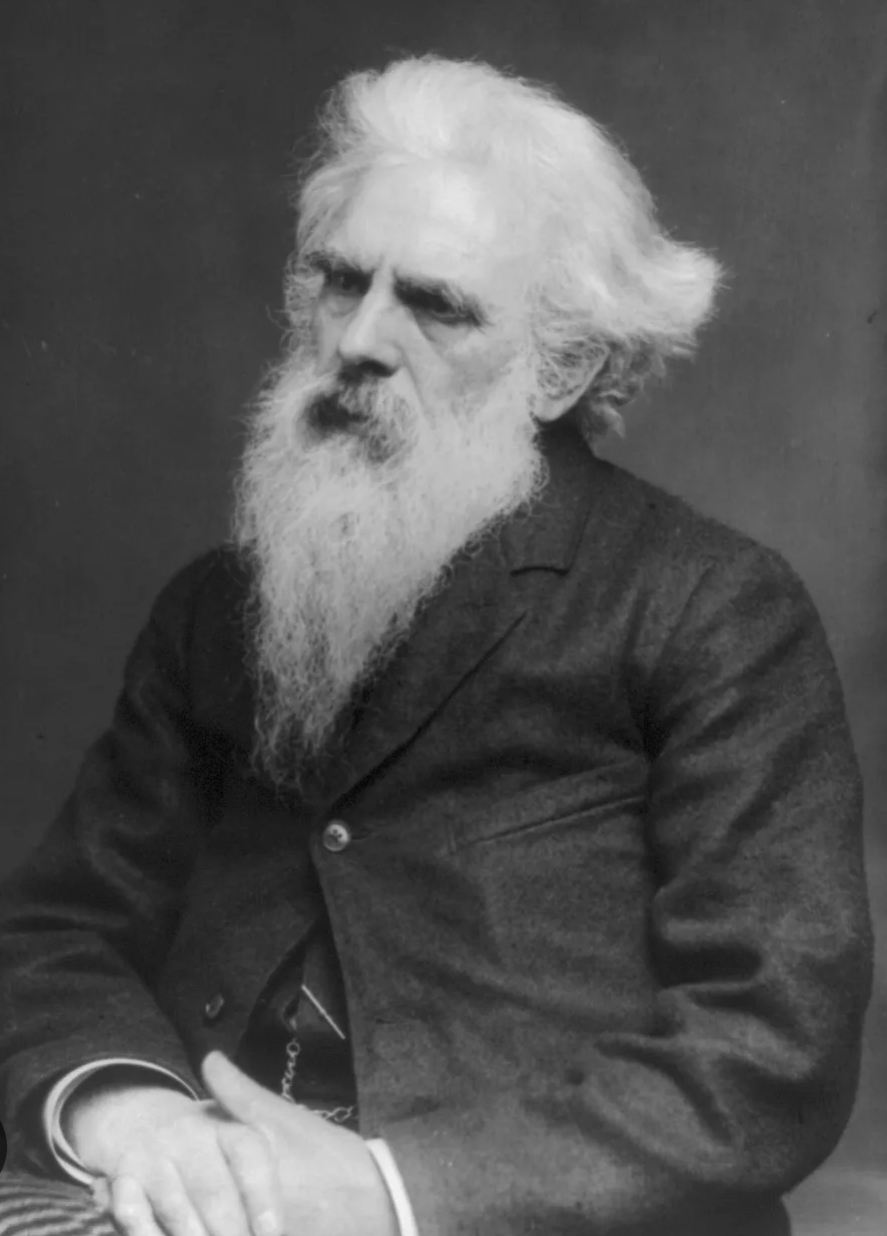
(photographed by Johnston, F. B., ca.1890, collection of the Library of Congress)
Eadweard Muybridge, Kingston’s Famous Photographer
Eadweard Muybridge was born Edward James Muggeridge on 9 April 1830 in Kingston upon Thames, an ancient market town located 10 miles south-west of Central London. At the age of 20, Muybridge decided to leave his hometown and sail to America in search of a new life. When he departed from the UK, he told his grandmother, “I’m going to make a name for myself. If I fail, you will never hear from me again.” He sincerely meant it and succeeded in achieving what he set out to do. Over the course of his four-decade career abroad, he changed his name three times: to Edward Muygridge, Edward Muybridge, and finally, Eadweard Muybridge in 1881. He also murdered his wife’s lover but walked free as the jury returned a verdict of ‘justifiable homicide.’
Muybridge’s innovative photographic motion studies, moving image projection, and eventful personal life have captivated many creative minds. His life and work have had a profound influence on the visual arts, film, animation, literature, opera, science, and technology. Examples include Francis Bacon’s painting Two Figures (1953), Philip Glass’s opera The Photographer (1982), and, more recently, Harvard University’s research on encoding Muybridge’s moving horse in the DNA of a living cell.
After a long and prolific international career, Muybridge returned to England in 1894 and spent his final ten years in his hometown. He bequeathed the extensive archive of his work to Kingston Museum. He died of cancer on May 8, 1904.
Visionary Landscape Photographer
When he first moved to America in 1850, Muybridge worked as a bookseller, initially in New York and later in San Francisco. In 1860, he was involved in a fatal stagecoach accident that left him with an injury of long-lasting impact. Muybridge spent several years recuperating in the UK. During that time, he explored different career paths, including inventing a washing machine for which he obtained a British patent. He also briefly served as the director of an investment bank. However, none of these ventures proved successful.
In 1866, Muybridge returned to San Francisco. This time, he took up photography. He became a landscape photographer, capturing urban and nature scenes in California. The photographic process in those early days was arduous, especially for outdoor photography. Photographs were taken on glass plates using wet chemicals, and the negative plates had to be developed immediately in a portable darkroom before the chemicals dried. Muybridge transported his cameras and photographic equipment in a small horse-drawn wagon, which he called the ‘Helios Flying Studio’. Helios means Sun God in Greek mythology.
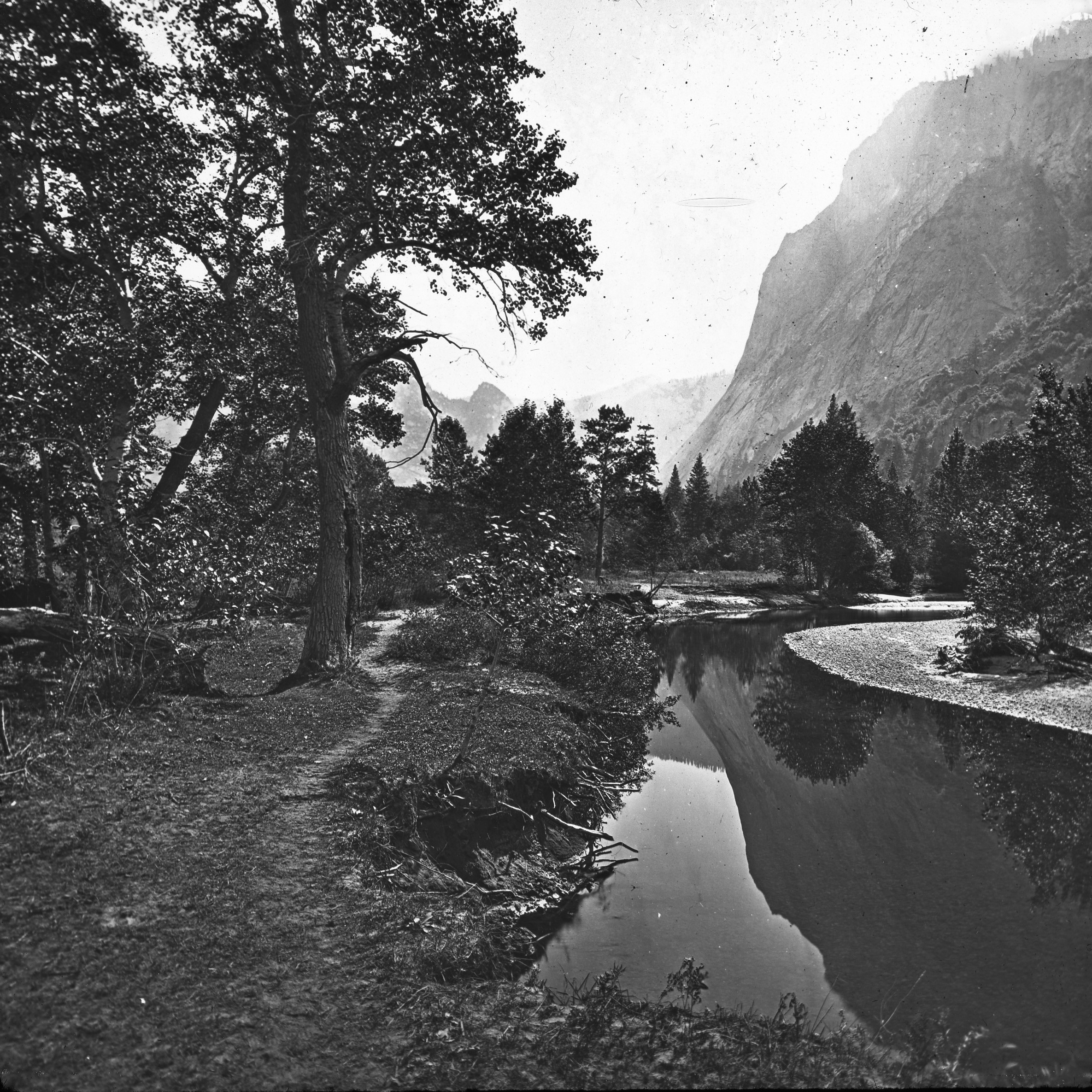
Muybridge captured the wilderness and beauty of nature, most notably Yosemite. He also documented the expansion of San Francisco, railroads, and other areas in California. Muybridge travelled further afield to undertake commissioned photography projects. His images of Alaska (1868) and Central America (1875) were among the first taken of those regions.

Four Feet Off the Ground
Leland Stanford, a former governor of California, railroad tycoon, and horse breeder, first hired Muybridge in 1872 to photograph his celebrated racing horse, Occident. This was to settle a long-standing debate about whether a galloping horse lifts all four feet off the ground at any point. Despite people’s doubts, Muybridge succeeded in taking a picture of the moment this occurred.
Six years later, in 1878, Muybridge developed a new method for capturing instantaneous photographs of a moving horse. He set up a line of 12 evenly spaced cameras at Stanford’s Palo Alto Stock Farm. Thin strings were stretched across a track where a horse would run or walk, with one end of each string attached to a camera. As the horse passed, the strings broke, triggering the cameras to take pictures in sequence. Muybridge gained international fame when these first-ever instantaneous sequential photographs of a ‘flying horse’ were published. Muybridge later increased the number of cameras to 24 and improved his devices by using electromagnetic shutters to capture more accurate and better-focused photographs. He also photographed various animals and humans performing different movements. Muybridge compiled his pioneering photographs and published The Attitudes of Animals in Motion (1881).
Animal Locomotion
In 1884, Muybridge began his new, more extensive photographic experiments at the University of Pennsylvania. Over the next two years, he captured more than 20,000 photographs of various animals and humans performing different movements. During this time, he utilised the dry-plate photographic process. Unlike the earlier wet process, the dry negative plates could be developed later after exposure. This improved method allowed Muybridge to work more quickly and efficiently. It also provided him with the flexibility to work with a wide range of photographic subjects, techniques, and locations. Muybridge photographed numerous humans and domestic animals simultaneously from different angles at a specially designed outdoor studio on the university campus, and he took pictures of wild animals at a local zoo.
Muybridge selected his photographs and arranged them into 781 plates through complex multiple processes. In 1887, he published them in his acclaimed work, Animal Locomotion, using a high-quality collotype printing process. Animal Locomotion remains the most comprehensive photographic motion study ever produced. His work has influenced countless artists, animators, and filmmakers over the past century, including Edgar Degas, Walt Disney, and the Wachowskis.
Muybridge undertook his motion studies primarily for scientific purposes. Many humans, often nude, and animals were photographed in front of fine grids so that the details of their body movements could be recorded and examined. Those images were intended to be objective and accurate. However, over the years, scholars have uncovered intriguing, yet contradictory, details about Muybridge’s work, including fictitious, manipulated arrangements of images.


Muybridge, Lantern Lecturer
Muybridge made headlines in 1878 when he took sequential photographs of a galloping horse. It was the first time a photographer had captured such rapid motion in real time. To prove his images were authentic, Muybridge projected the moving image recreated from his photographs using his invention, the Zoopraxiscope. Since the first public demonstration of his apparatus on 4 May 1880 at the San Francisco Art Association, Muybridge performed hundreds of lectures to a variety of audiences in America, the UK, and Europe for over 15 years.
While distinguished by his unique moving image projection with the Zoopraxiscope, Muybridge’s presentation was essentially a lantern lecture – a popular form of entertainment and education at the time. Lantern lecturers illustrated their talks using glass slides, projected through a magic lantern, an early image projector. At times, Muybridge delivered some of his lectures solely with a magic lantern, without using the Zoopraxiscope. In addition to his own work, Muybridge often showed images of various historical and contemporary artworks as references to affirm the credibility and accuracy of his photographs.
In the 1880s and 1890s, Muybridge toured America, the UK and Europe, giving lectures to a range of audiences. One of his notable endeavours was the 1893 Chicago World’s Fair, where he constructed a venue for his projection lectures, the Zoopraxographical Hall. It was the world’s first purpose-built moving picture theatre. However, this venture did not attract the crowds Muybridge had hoped for. While his projection method remained largely unchanged, other inventors began to develop new moving image technologies in the early 1890s. For instance, Thomas Edison launched his Kinetoscope in 1894, and the Lumière brothers held their first public screening in 1895 with their Cinématographe.
After returning to Kingston in 1894, Muybridge resumed his lecture tour in the UK for one more season, from 1895 to 1896. His last known lecture took place in 1897 in St Ives. During his final years, Muybridge focused on two publications: Animals in Motion (1899) and The Human Figure in Motion (1901). Both books became popular and were released in multiple editions.